Published by:
CGP EDU Academic Team
Published on: September 13, 2026
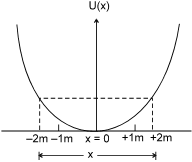
The potential energy function for a particle executing linear simple harmonic motion is given by U (x) =  kx 2 , where k is the force constant. For k = 0.5 N m –1 , the graph of U(x) versus x is shown in figure. Show that a particle of total energy 1 J moving under this potential ‘turns back’ when it reaches x = ± 2m.
Text Solution
Verified by ExpertsThe correct answer is:
A
The potential energy function is given as $U(x) = \frac{1}{2} k x^2$. For this problem, we have $k = 0.5 \, \text{N m}^{-1}$. Thus, we can write the potential energy as:
Step 1: Substitute the value of k into the potential energy function:
$$U(x) = \frac{1}{2} \times 0.5 \times x^2 = 0.25 x^2$$
Step 2: Calculate the potential energy at $x = 2m$ and $x = -2m$:
$$U(2) = 0.25 (2)^2 = 0.25 \times 4 = 1 \, \text{J} $$
$$U(-2) = 0.25 (-2)^2 = 0.25 \times 4 = 1 \, \text{J} $$
Step 3: The total mechanical energy E of the particle is the sum of kinetic energy (K) and potential energy (U):
$$ E = K + U $$
When the particle reaches $x = ±2m$, the potential energy $U(x)$ is equal to the total energy $1 ext{ J}$. This means that the kinetic energy $K$ will be zero at these points because:
$$ K = E - U \implies K = 1 - 1 = 0 \text{ J} $$
Hence, at $x = ±2m$, the particle has zero kinetic energy, causing it to 'turn back' or reverse its motion. Therefore, the particle will stop and change direction upon reaching these points.
Step 1: Substitute the value of k into the potential energy function:
$$U(x) = \frac{1}{2} \times 0.5 \times x^2 = 0.25 x^2$$
Step 2: Calculate the potential energy at $x = 2m$ and $x = -2m$:
$$U(2) = 0.25 (2)^2 = 0.25 \times 4 = 1 \, \text{J} $$
$$U(-2) = 0.25 (-2)^2 = 0.25 \times 4 = 1 \, \text{J} $$
Step 3: The total mechanical energy E of the particle is the sum of kinetic energy (K) and potential energy (U):
$$ E = K + U $$
When the particle reaches $x = ±2m$, the potential energy $U(x)$ is equal to the total energy $1 ext{ J}$. This means that the kinetic energy $K$ will be zero at these points because:
$$ K = E - U \implies K = 1 - 1 = 0 \text{ J} $$
Hence, at $x = ±2m$, the particle has zero kinetic energy, causing it to 'turn back' or reverse its motion. Therefore, the particle will stop and change direction upon reaching these points.
Prepare Smarter with CGP Edu
Get practice questions, solutions, and test series in one place.
Write a Review
Share your experience with this question and solution.
Commentary
Send your comment, doubt, correction, or feedback to admin.
Similar Questions
Explore conceptually related problems
A force F = x 2 y 2 i + x 2 y 2 j (N) acts on a particle which moves in the XY plane.
Calculate the forces F(y) associated with the following one-dimensional potential energies:
The potential energy function of a particle in a region of space is given as:
U = (2x 2 + 3y 3 + 2z…
Force acting on a particle in a conservative force field is:
(i)
(ii)
(iii)
The potential energy for a force field is given by U (x, y) = sin (x + y). The force acting on the…
The potential energy of a system of two particles is given by U(x) = a/x 2 – b/x. Find the minimum …